Establishes what your process actually does before anything is modeled: work content, cycle times, constraints and staffing, measured rather than assumed. Every engagement starts here, and some end here, because the measurement alone settles the question.
About LeanSimCorp
Industrial engineers who model before they recommend.
A simulation and industrial engineering practice, working with manufacturing and operations teams since 2021 on the questions a spreadsheet cannot settle.
Engineers do the work, from understanding the process to checking model assumptions and comparing alternatives with your team. Based in India, serving teams worldwide.
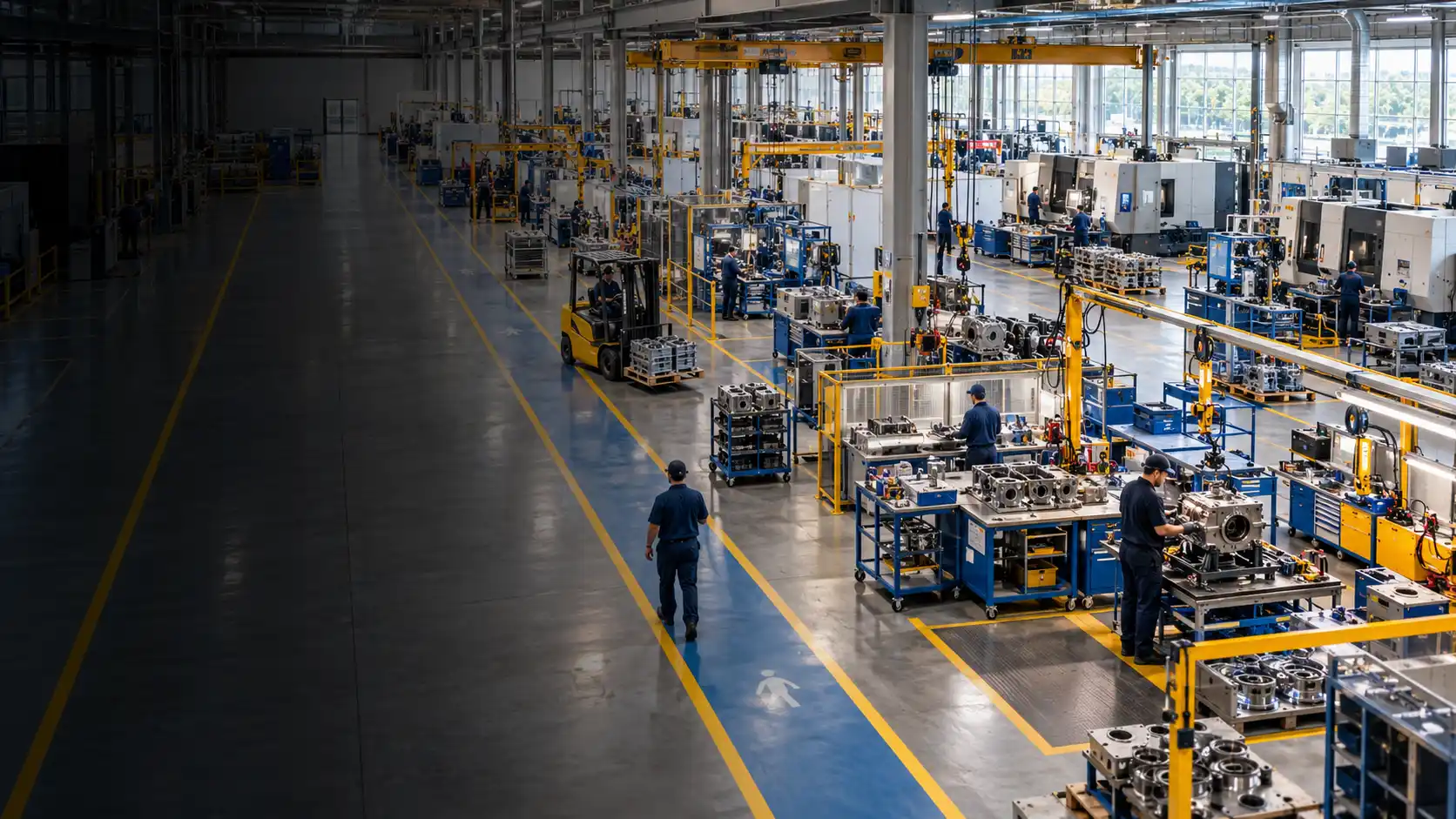
Every station is part of a larger system. Illustrative image, not a client facility.
Before the investment
What changes if we add another shift?
- Measure
- Model
- Compare
A connected engineering practice.
2021Supporting industry since
20+Companies supported
GlobalSupport across customer facilities
The short version
Since 2021 we have worked with manufacturing and operations teams on capacity, layout, material flow, manpower and downtime: questions where the answer depends on variation, queues and breakdowns, and an average tells you nothing. We start with industrial engineering and bring in simulation, analytics or AI only when the problem needs them. Ten of these questions come up often enough that each has its own page.
From the plant to the decision
Manufacturing, automotive, FMCG, warehousing and logistics are among the settings our work addresses. Our service pages explain the operating questions and the evidence a study can provide.
View the study outcome figures ↗- Project support
- Work scoped to a specific operational decision, with clear assumptions, deliverables and checkpoints. Bring us a problem ↗
- Training
- Structured FlexSim courses and assessments on our own platform, free worked examples on the channel, and notes on the blog. Training platform ↗
The disciplines
One problem. The right combination.
Bring the problem, not a method. Often it needs two disciplines, occasionally all four. Now and then the honest answer is a spreadsheet and an afternoon. Saying so costs us a project, which is roughly what a partner is for.
Builds a working model of your plant in FlexSim that runs the variation, failures and queues a spreadsheet averages away. A layout, fleet size or shift pattern is tested before it is paid for.
Turns what your plant already records into something a decision can rest on: cleaned data, distributions instead of averages, and scenarios compared on one basis.
Brings in Python, machine learning and vision where they beat the simpler method. That might be a dispatching policy tested against the model, or the short stops that manual logging misses, recorded automatically.
How a problem is worked
Six steps. The tools come in at step three.
Follow the work from a real operating question to a tested recommendation. The illustration builds as you move through the steps.
From observation to evidence
Understand the real flowTest the alternativesExplain the decision
Understand
The process, its constraints, and the decision you need to make.
Measure
Cycle times, events, downtime and performance data from the real system.
Model
Discrete event simulation, digital twin or analytical model — whichever fits.
Enhance
Python, AI/ML and automation where they add real value.
Optimize
Compare alternatives and identify what is worth implementing.
Decide
Evidence your team can defend in a review.
Working together
Partners, not suppliers.
The same problem, from the same side of the table. Here is what that means in practice.
Advice you can challenge
We explain the assumptions and evidence behind a recommendation. Your team can question both before committing to a change.
You keep the model and the method
The agreed deliverables include the model or workbook and its assumptions. Running or editing a simulation model may require the appropriate software license. We agree the access and handover requirements in the project scope.
An engineer’s answer, not a proposal
A question that arrives after handover, on a Tuesday about a line that has changed, gets an engineer’s answer first. Whether it becomes another project is decided after that.
Sensitive information, handled deliberately
If your organization uses an NDA, share it with us for review before sending sensitive drawings or datasets. We agree how project information will be handled.
Ten domains
Where we are called in most
Each page explains the operating challenges, what goes into a study and the decisions it can support.
Next step
The quickest way to find out if we fit is to ask.
Tell us the process and the decision you are weighing. We will discuss a sensible scope and the information needed to begin.
projects@leansimcorp.com