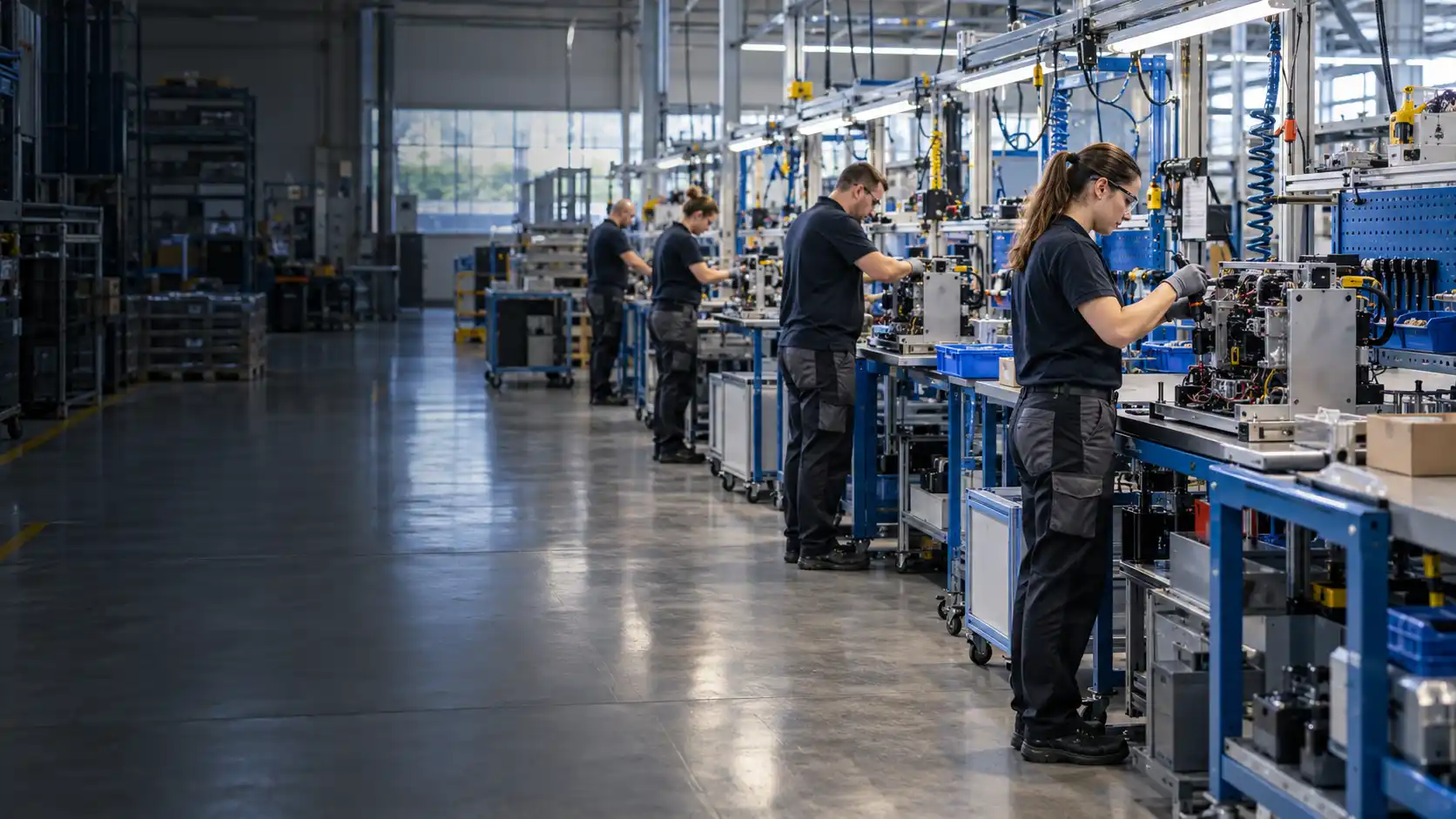
Observe tasks at the operation.Green units show work content; amber marks the overloaded station.The same task units move between stations to illustrate an allocation option.Review the measurements, constraints and resource options together.
Illustrative assembly line · not a partner operation
Industrial Engineering.
Measure the work. Improve the flow.
Industrial engineering consulting for line balance, capacity and staffing. We establish how the operation runs today, then evaluate practical improvements around your business decision.
Measured work content comes before another model or another machine.
See the work. Beyond standard times.
We observe tasks, cycle times and operating conditions station by station. That establishes what the process can deliver, where time is lost and what the current staffing pattern means.
Work content and cycle-time variation
Changeovers, downtime and available time
Demand, product mix and staffing
A measured baseline.
The process as it runs—not only as it was specified.
Balance the work. Before investing.
Uneven task allocation can leave one station waiting while another carries the load. We evaluate practical changes against takt, task constraints and the way people and equipment interact.
Compare workload across stations
Evaluate tasks, people and shift patterns
Prioritize the constraint that matters
Equal-sized task units and the reference line are illustrative—not measured times, plant takt or a constraint-validated balance.
A clear priority. An actionable next step.
Your team gets the measurements, assumptions and resource options needed to review the decision. We explain whether direct analysis is sufficient or simulation is worth the additional work.
A stable process may need a time study and a workbook. Where variation and shared resources materially change the answer, simulation can extend the analysis. We establish the method before committing to the model.
Distinguish equipment limits from lost time, uneven work and operating constraints before committing capital.
Put resources where they matter
Evaluate staffing, shifts and task assignments against demand, product mix and the work itself.
Prioritize the next improvement
Give leadership and the plant team a shared, measured basis for deciding what to change first.
From evidenceto a usable decision.
01
Establish the operating baseline
Observe the process and reconcile cycle times, work content, demand and available operating time.
02
Evaluate practical alternatives
Compare workload, constraints and resource options. Use simulation only when the interactions call for it.
03
Make the decision usable
Explain the findings, assumptions and recommended priorities in a form your team can act on.
The engineeringbehind the decision.
The discipline underneath the model. Work content, cycle times, constraints and manning, established before anything is simulated.
Our approach+
Before a model is worth building, the process has to be understood and measured: what the work content really is at each station, how long a cycle takes when nothing goes wrong and how often something does, where changeovers and breakdowns actually fall, and how many people the line is run with on each shift. That is industrial engineering, and it is the foundation the rest of the toolkit sits on. It is also the reason we sometimes tell a partner not to commission a model at all.
Choosing the right method+
A time study and a spreadsheet may be sufficient for a stable line and an average-capacity decision. Simulation earns its cost when variation, interaction and queueing materially affect the answer. We establish which method the decision needs before building a model.
Measuring work content+
We measure work content station by station against takt, rather than relying only on historical standard times. Comparing actual tasks, cycle-time variation and task assignments shows where workload differs from the plan and where balancing work should begin.
Sizing staffing and shifts+
Sized against demand as it varies rather than against its average, and split by shift. Manning set against the average is comfortable on a normal week and short on every other one, which is how overtime becomes structural without anyone ever deciding that it should.
What decisioncomes next?
Tell us what you are planning, what you want to improve and when you need to decide. We’ll discuss the engineering approach, project scope and next steps.