New FlexSim models
From process data and operating rules to a working model of your line, warehouse or material-handling system, with the decision and the validation basis agreed before building.
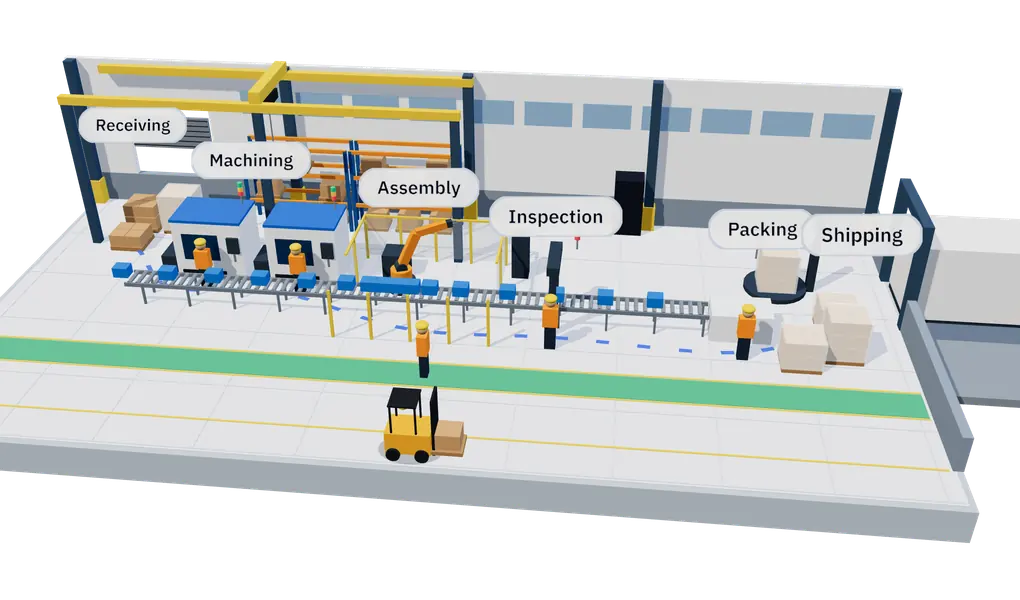
Build it, fix it, or get a clear answer from it.
Engineers who work in Autodesk FlexSim for manufacturing, warehouse and material-handling teams: new models, help with models that are stuck, and scenario studies your team can defend. Remote, for teams worldwide.
At the start of a FlexSim project, halfway through one that has stalled, or when the results need a second pair of eyes before a decision rests on them.
From process data and operating rules to a working model of your line, warehouse or material-handling system, with the decision and the validation basis agreed before building.
Tokens stuck in Process Flow, task sequences that never finish, operators or AGVs that deadlock, results nobody trusts. We find the cause, fix it and explain what changed.
Layouts, buffers, staffing and fleet options compared on one basis in the Experimenter, with replications and ranges rather than a single run read as fact.
AGVs and AMRs, conveyors, racks, picking and docks: fleet sizes, congestion and traffic rules tested in the model before equipment is ordered.
Connect PLC or soft-controller logic to a virtual plant in FlexSim and exercise the difficult cases before commissioning, not on site.
Process Flow · FlexScript · Experimenter · OptQuest (where your license includes it) · AGV & A* navigation · Conveyors · Operators & task sequences · Dashboards & statistics · Excel import/export · Emulation
Working FlexSim model + Scenario results with ranges + Documented assumptions and limits
* Upper end of what studies have returned across engagements, not a promise for every plant. What yours would return depends on where the constraint actually sits.
A clear scope and a usable handover. 6+ years supporting industry, 20+ companies served across 10 sectors, working with manufacturing and operations teams since 2021.
From an engineer, not an autoresponder, usually with a question or two about the decision behind the request. Messages are welcome seven days a week; our time zone is IST.
We review your process, objectives, the data that exists today and any existing model, and say plainly whether simulation is the right tool for the question.
Inputs, assumptions, checkpoints and deliverables are agreed in writing before building, so the result can be checked against them.
The model is checked against your current operation before any scenario is trusted, then the options are compared on the same basis.
Depending on the scope: the working FlexSim model, validation findings, scenario comparisons and recommendations.
What teams usually ask before bringing us into a FlexSim project.
Help from experienced modelers at any point in a FlexSim project: building a new model, fixing or extending an existing one, designing experiments, or checking whether the results can be trusted. It can be a focused fix or a full simulation study, scoped before any work starts.
Yes. Common causes are Process Flow logic that conflicts with 3D port connections, invalid list or label references, and task sequences that never release. Send the model, your FlexSim version and what you expected to happen. We set out what holds and what does not before changing anything.
Day to day: Process Flow, FlexScript, the Experimenter, AGV networks, conveyors, operators and task sequences, dashboards, and Excel import and export. OptQuest where your license includes it, and emulation for control testing before commissioning.
No. FlexSim is now sold by Autodesk as Autodesk FlexSim; the software is not ours to sell, and we do not sell it. Commercial work needs an appropriate license from its owner. Tell us which FlexSim version your team uses when you get in touch.
It depends on the scope. A focused fix or model review is much shorter than a new model with validation and scenario studies. After the scoping conversation, checkpoints and a timeline are agreed in writing, so you know what arrives when.
By scope: the questions the model must answer, the size of the operation and the data available. The inputs, assumptions, checkpoints and deliverables agreed at the start are what the project is quoted against.
Teams in the United States and other international markets engage our India-based engineers for simulation projects. Email is our main project channel, we reply within 1–2 days, seven days a week, and checkpoints are agreed at the start of the project.
A short summary is enough: the process, the decision the model should support, and what data exists today, such as layouts, process times, volumes and operating rules. Where an input is unavailable, we agree an assumption and record it.
If your organization uses an NDA, share it with us for review before sending models, drawings or datasets. Nothing from a project appears on this site; work is described by sector and scale only.
Depending on the scope: the working FlexSim model, validation findings, scenario comparisons with ranges, and recommendations, with inputs, assumptions and limits documented.
Yes, separately from project work: structured FlexSim courses and assessments on our training platform, and free worked examples on our YouTube channel.
FlexSim simulation support and consulting.
Tell us the operation, the decision the model will support, your FlexSim version and what data exists today. We’ll set out whether simulation is the right tool and what the work should cover.
FlexSim is a trademark of FlexSim Software Products, Inc., an Autodesk company. LeanSimCorp is an independent consultancy, not affiliated with, endorsed by, or a reseller for FlexSim or Autodesk. Disclaimer